Wisdom teeth extraction
Wisdom Teeth Removal in Richmond
Expert care for straightforward and complex wisdom tooth cases
Wisdom teeth, also known as third molars, are the last teeth to develop and usually appear between the late teens and mid-twenties. While some wisdom teeth grow normally and cause no problems, others may become impacted, partially erupted or trapped beneath the gum or bone, leading to discomfort and other dental problems.
At Richmond Dental Centre, wisdom tooth removal is carried out by Dr Tiago, who has a particular interest in managing complex and challenging surgical cases.
Whether Your wisdom tooth is causing discomfort or Your dentist has identified a potential problem, we can assess Your case and recommend the most appropriate treatment.
When does a wisdom tooth need to be removed?
Not every wisdom tooth needs to be extracted. If a wisdom tooth is healthy, fully erupted, functional and easy to keep clean, it may simply be monitored.
Removal may be recommended when a wisdom tooth is causing, or is likely to cause, problems such as:
- Recurrent pain or swelling
- Infection around a partially erupted tooth
- Impacted wisdom teeth
- Recurrent pericoronitis
- Tooth decay in the wisdom tooth or neighbouring tooth
- Gum disease around the wisdom tooth
- Food trapping and difficulty maintaining good oral hygiene
- Cysts or other changes associated with the tooth
- Damage or pressure affecting the neighbouring molar
- Insufficient space for the wisdom tooth to erupt normally
Our approach is to assess each case individually and recommend extraction when there is a clear clinical reason to do so.
Complex and impacted wisdom tooth removal
Some wisdom teeth are considerably more difficult to remove than others.
A tooth may be deeply impacted within the jaw, positioned at an unusual angle, partially covered by bone or located close to important anatomical structures. These cases require careful assessment and surgical planning.
Dr Tiago takes on complicated wisdom tooth extraction cases, including challenging impacted teeth that may require a more surgical approach.
The aim is to remove the tooth as safely and conservatively as possible while protecting the surrounding teeth, bone and soft tissues.
What happens during Your consultation?
Before recommending wisdom tooth removal, Dr Tiago will assess Your tooth, surrounding tissues and overall dental health.
Depending on the complexity of the case, appropriate dental imaging may be recommended to understand the position of the wisdom tooth and its relationship with the surrounding structures.
Your consultation is an opportunity to discuss:
- Why the wisdom tooth may need to be removed
- How complicated the extraction is likely to be
- Whether surgical extraction is required
- The potential risks and benefits
- What You can expect during recovery
We believe You should understand Your treatment options before making a decision.
Surgical wisdom tooth extraction
A straightforward wisdom tooth can sometimes be removed in a similar way to any other tooth. However, impacted or complicated wisdom teeth may require surgical extraction.
This can involve making a small opening in the gum, removing a small amount of surrounding bone or dividing the tooth into sections so that it can be removed safely.
Dr Tiago’s experience with more complex cases allows him to carefully plan the procedure according to the individual anatomy and position of the tooth.
Wisdom tooth removal for nervous patients
We understand that the idea of having a wisdom tooth removed can be daunting, particularly when You have been told that Your case is complicated.
Our team will explain the procedure clearly beforehand and make sure You understand what to expect. We take a calm, measured approach and prioritise Your comfort and safety throughout treatment.
Do all wisdom teeth need to be removed?
No.
The decision to remove a wisdom tooth should be based on your individual circumstances rather than simply because it is a wisdom tooth.
If Your wisdom tooth is healthy, functional and can be maintained, monitoring may be appropriate. If it is repeatedly becoming infected, damaging neighbouring teeth or causing other problems, removal may be recommended.
An assessment with Dr Tiago can help determine which approach is right for You.
Complex wisdom tooth extraction in Richmond
If You have been told that Your wisdom tooth is impacted, difficult to remove or close to important anatomical structures, Dr Tiago can assess Your case and discuss the available options.
We welcome second opinions for complicated wisdom tooth cases, particularly where You would like a clearer understanding of whether removal is necessary and how the procedure can be approached.
Book Your wisdom tooth consultation
If You are experiencing pain, swelling or recurring infection around a wisdom tooth, or have been advised that You need a difficult extraction, contact Richmond Dental Centre to arrange a consultation with Dr Tiago.
Expert assessment and treatment for straightforward and complex wisdom tooth cases.
0% Finance Available
We offer the following surgical treatments:
Book an implant consultation with surgeon Dr.Tiago

SINGLE TOOTH REPLACEMENT
Current science supports valid evidence that dental implants are a better solution to other treatments such as conventional bridges or dentures.
In case of a bridge, the missing tooth replacement needs to be bonded to the adjacent teeth. That type of restoration might compromise the adjacent teeth, the teeth might need to be trimmed down. There is the additional issue of placing the unnecessary pressure and weight on the adjacent teeth not to mention the additional risk of bridge de-bonding. This happens often when there is a strong bite.
Similarly a denture can destabilise adjacent teeth and move during eating or speaking.
A dental implant has the benefit of functioning as an independent item and not having to rely on adjacent teeth. It has the additional benefit of stimulating the bone to stay dense and ever get stronger. Either bridge or a denture is not able to provide that.
MULTIPLE TEETH REPLACEMENT
In cases where more than one tooth is missing a multiple implants can be placed in the same jaw bone.
It is worth noting that in general it is more suitable to keep natural teeth separate from implants as implants are rigidly attached to the bone but natural teeth move very slightly as these are being supported by periodontal ligament in the bone. Periodontal ligament is a form of suspension and a shock absorber for the natural dentition.
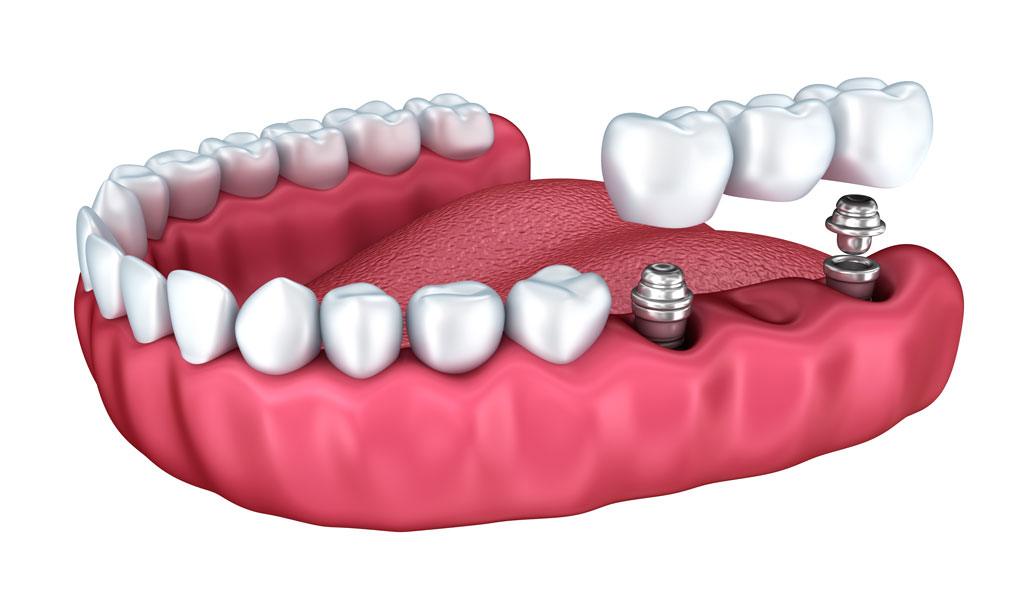
Groups of missing teeth can be replaced with a bridge supported by dental implants. One of the examples could be a replacement of three teeth in one quadrant of the mouth. The heavier the biting forces the more implants are necessary. The advantage is not having to prepare the adjacent teeth to support the bridgework.
The benefit is such that the construction of implant supported bridge does not rely on the remaining dentition.
DENTURES: stabilising dentures with implants
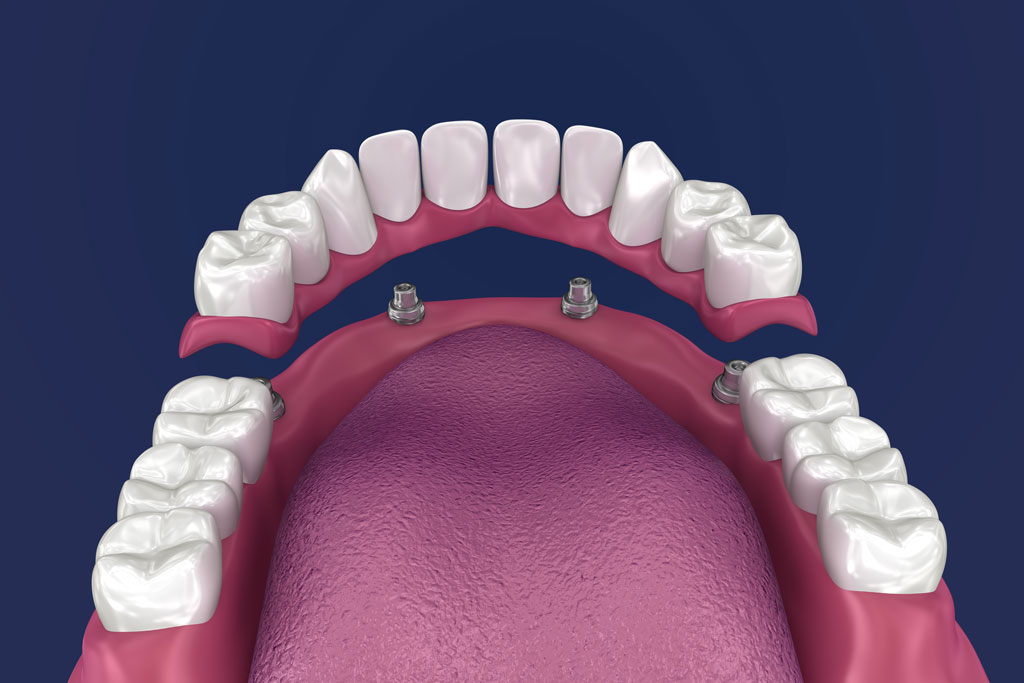
Loose dentures can be stabilised with either two or three implants in the lower – bottom – jaw. In the upper jaw – top jaw- this can be achieved with a minimum of four implants.
The “clip on” mechanism allows dentures to be secured and safely positioned.
This option is usually more cost effective than fixed bridgework.
Frequently patients upgrade to fixed bridgework from dentures after a while. Patients find that dentures “can age” sometimes and may alter speech a little. However it is a very good alternative in cases where budget is constrained. What’s the next step?
To find out how our skilled dental implant dentist can help you to eat better and feel more comfortable, call us today to book Your consultation.
Fixed Bridgework
Implant supported bridge looks very similar to a conventional dental bridge. The difference is that it is fully supported by implants only.
Frequently, in case of implant supported bridge, one implant is placed in the jawbone for each missing tooth. Then the crowns are joined together to form a continuous piece.
In other cases the implants might be placed at a small distance to each other to suspend a bridge over the area with insufficient bone presence etc.
When is it used?
- When more than one tooth is missing
- When there is a risk that the patient is clenching or grinding the teeth putting too much pressure on individual implants in the bone. The bridgework is there to protect the implants and spread the heavy bite forces into the entire structure.
- When there isn’t enough bone in the jawbone or the location is too close to a nerve or a sinus cavity in the upper (top) jaw.
Typically four to six implants are required to support entire dental arch. Where the bone is limited, it may take just four dental implants. If plenty of jaw bone is available, more implants may be placed to support a series of smaller bridges or individual teeth where aesthetics play a role.

All-on-4
Developed in the 1990s this revolutionary procedure uses just four implants where the bone of the jaw is most dense. The 4 implants are placed at a specific sites and specific angle to support a bridge of 12 teeth. The temporary bridge is then attached on the same day so patient is never left without the teeth.
After approximately 5/6 months when the healing took place in the jaw and implants have integrated with the bone, a titanium based permanent bridge is fitted.
This solution is ideal for patients who have lost teeth over the years and had to suffer ill fitting dentures as a result.
To arrange an initial examination and consultation, contact us at in**@*********************co.uk or telephone on 020 3441 8182.
BONE GRAFTING
Where he tooth or teeth were extracted a long while back, bone loss may occur. In areas where bone is thin or too soft the bone graft might need to be placed in order to secure and hold the implant. If the bone cannot support the implant, it may cause the digitally placed implant to fail.
How is the procedure carried out?
In cases where a lot of bone is missing, it may be possible to rebuild it using it the bone material from another part of the body. This usually requires a short hospital procedure.
However, in a case where a smaller section of the bone is missing, the surgeon can place a special bone grafting material.
We use a material which allows the cells of the body to remodel the graft into a normally functioning bone. After a few months restored jaw will have enough bone thickness for a placement of a dental implant.
The advantages are
- Relatively readily available bone substitute
- No second surgical site
- Clinically proven effectiveness
- Great track record of safety
Typically it takes approximately 6 moths before implants can be placed after the bone graft placement. Please enquire with one of our clinicians to ask about bone grafting.